

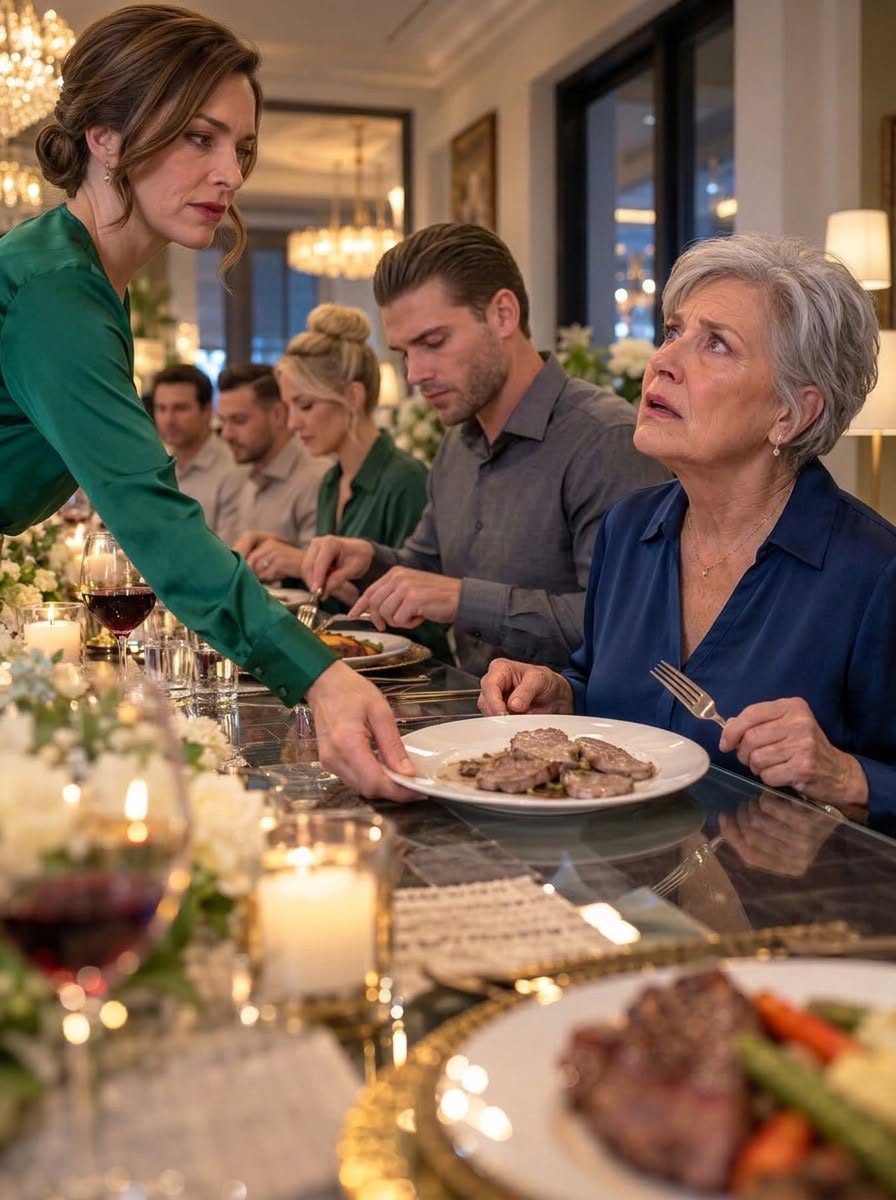
At seventy-three, I watched my son’s family eat steak while his wife put a cold leftover on my plate. That night, I found an email asking how my son could gain access to my investments. I went to the bank at dawn to stop paying his bills, and the banker turned her screen toward me. Someone had tried to withdraw money from my account at 5:42 that morning…
Madison put my plate down after everyone else had begun eating. Daniel had a thick steak, and so did his wife and the guests seated along their glass dining table. Mine held one thin slice with stiff, gray edges. It was cold when I touched it with my fork. I looked to see whether Madison had made a mistake, but she was already reaching for a guest’s wineglass.
I was seventy-three years old, old enough to know that a dinner invitation doesn’t guarantee a welcome. Still, I’d driven across Los Angeles because my son had called that afternoon and said, “Come over, Mom. We’d like to see you.” they’d squeezed an extra chair onto the end of the table. there was no napkin at my place, and my water glass was the only one without wine.
Daniel laughed at something a guest said about a weekend in Napa. briefly I heard the boy who used to call me down to the Santa Monica shore to watch him race the waves. Then I watched the man across the table adjust his smile when Madison spoke, keeping his eyes on the guests. I’d come hoping to talk to him, but there seemed no polite way to begin across fourteen feet of glass and a centerpiece large enough to hide behind.
They discussed renovations and a possible retreat in Napa. I knew the cost of the private school Lily and her younger brother attended because I paid the tuition. When the family car failed, I helped buy its replacement. Hearing Daniel speak about what “we’re managing to do for the kids” while I sawed at my cold meat took work to swallow.
Lily caught my eye once. She is a thoughtful girl, quick to notice when somebody has gone quiet, and I could see her glance at my plate. Madison touched her shoulder and drew her attention back to the conversation. I gave Lily a small smile so she would not feel responsible for fixing a room full of adults. I’d been doing that for years, and the position was already occupied.
I said little for the rest of dinner. Dessert was a glossy tart that Madison served to the guests first; the small piece brought to me last slid around an otherwise empty plate. It would have been easy to make a scene over dinner and foolish to pretend dinner was the only problem. I thanked her when she cleared my dish, partly from habit and partly because I needed to hear how automatically I still said it.
At the front door, Daniel watched his phone. “Drive safe, Mom,” he said, without asking whether I’d enjoyed myself. I told him I always did. On the way to my old sedan, I nearly returned and asked him why he’d invited me. Instead, I got in the car and sat briefly, looking at the bright windows of the Santa Monica house I’d helped him buy.
Charles and I’d taught Daniel to say thank you when someone handed him a glass of water. After my husband died, I became less certain of what Daniel needed and much more willing to pay for whatever he said it was. His grief was real. So were the missed rent payments I covered, the debts from his first failed business, and the down payment that helped him buy this house.
We had called the down payment a loan. Nobody had mentioned a payment schedule in years. Later there were school fees for Lily and her brother, a family car, and a nanny during the months Madison said she couldn’t manage both children alone while Daniel’s career took off. Some of that help was necessary at the time. I was glad the children were cared for. I’d stopped asking myself when the emergencies had become a household budget that I supplied.
I’d worked as a financial controller for a logistics company, balancing payroll and asking people to account for every unexplained expense. At home, I was less rigorous. A transfer to Daniel had an explanation I already knew: he was my son. If Madison called because a payment was due, I moved the money and told myself love didn’t require a receipt.
My house was quiet when I returned. I put on the kettle and sat at the kitchen table Charles and I’d bought when Daniel was small. Its surface still had a faint ring from a hot pan he’d set down there at thirteen. I thought of the one napkin missing from Madison’s table and then of the mortgage draft I’d paid last month.
I entered my little office and took my binder from the shelf. The receipts were sorted by year, one habit from my working life that marriage and motherhood had never managed to dislodge. Tuition statements, bank transfers, insurance payments, and notes about which bill Daniel had promised to handle next lay in careful rows. The totals were substantial, but seeing them wasn’t what kept me in the chair.
Continue reading on the next page →