
Why Do We Say “O’Clock”? The Surprising History Behind a Word We Use Every Day
English is full of expressions we use automatically without ever stopping to wonder where they came from. Some words look as though they should rhyme but do not. Others are spelled exactly the same yet change pronunciation depending on their meaning. Then there are familiar expressions that sound perfectly natural to native speakers but can seem mysterious to anyone learning the language.
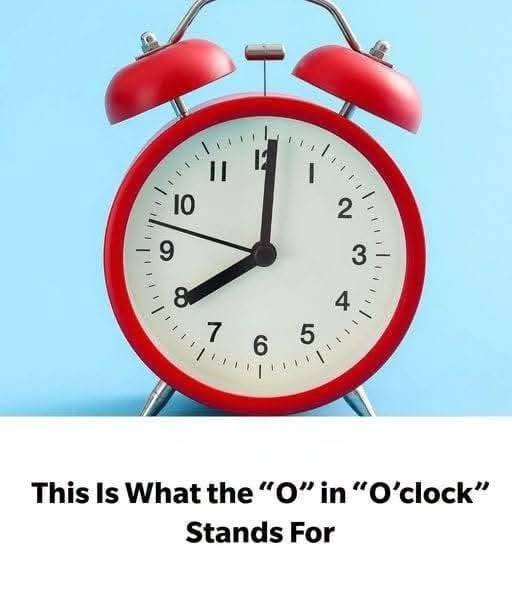
One everyday expression that rarely gets a second thought is “o’clock.” We use it constantly when telling time: three o’clock, six o’clock, ten o’clock. But what exactly does the little “o’” mean?
The answer is surprisingly simple, and it preserves a small piece of English history every time we say it.
What Does “O’Clock” Actually Mean?
The “o’” in o’clock is a shortened form of the older expression “of the.”
So when someone says:
It’s three o’clock.
Historically, that comes from:
It’s three of the clock.
In other words, the phrase originally meant that the hour was being given according to the clock.
That wording may sound strange to modern ears, but centuries ago it made much more sense.
Why Did People Say “Of the Clock”?
Before mechanical clocks became common, people had many different ways of estimating or measuring time.
They relied on things such as sundials, water clocks, candle clocks, hourglasses, church bells, and the position of the sun.
As mechanical clocks became increasingly common in Europe during the late Middle Ages, people sometimes needed to distinguish between an approximate hour and the hour actually displayed by a clock.
The phrase “of the clock” helped make that distinction.
If someone said “five of the clock,” they were essentially saying that it was five according to the clock rather than simply five by some other method of estimating time.
How “Of the Clock” Became “O’Clock”
Languages naturally shorten expressions that are used frequently.
When people repeat the same phrase thousands of times in everyday speech, unstressed sounds and words often become compressed.
Over time:
Five of the clock
became:
Five o’clock.
The shortened form eventually became the standard expression, while the full phrase largely disappeared from ordinary conversation.
This kind of change is common in language. Frequently used expressions are especially likely to be shortened because speakers naturally favor efficiency.
That tiny “o’” may look insignificant today, but it is actually a linguistic fossil preserving a much older way of telling time.