
My Best Friend Stopped Growing at Eight—Everyone Said He Would Never Find Love, Except Me
Part One: A Promise Written in Purple Crayon
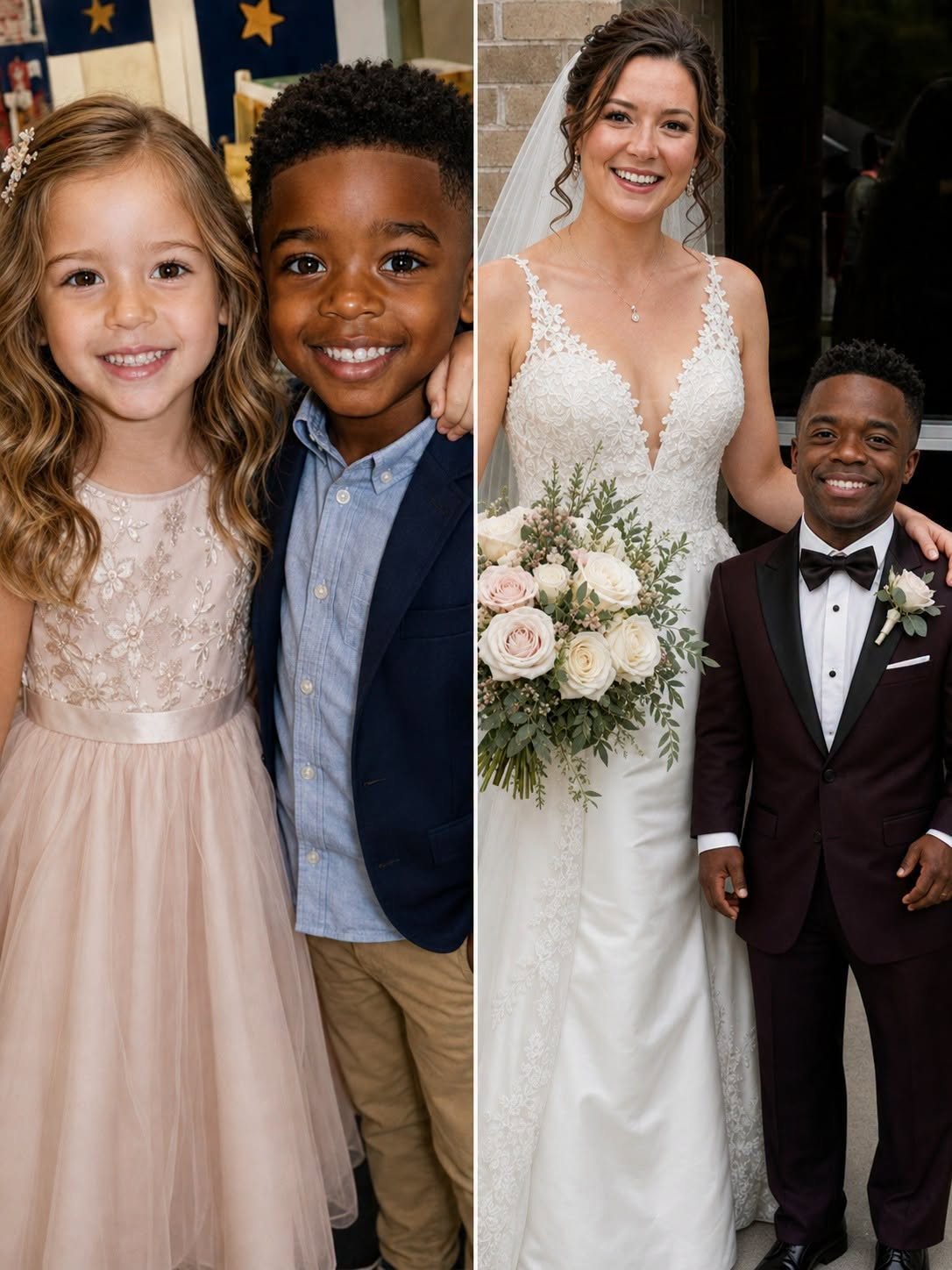
Noah and I were six years old when we decided we would marry each other.
The agreement happened behind the monkey bars during recess, far away from the teachers and the other children. I tore a page from my spelling notebook and wrote our promise in purple crayon.
“If neither of us is married by the time we turn thirty,” I announced, trying to sound official, “we will marry each other.”
Noah leaned closer and studied the paper.
“You spelled ‘promise’ wrong.”
“I did not.”
“You added an extra letter.”
“You still understand what it says.”
He released a long sigh, as though he had already spent years dealing with my stubbornness.
“Fine.”
He signed his name beneath mine.
Later that afternoon, we bought two plastic rings from a vending machine outside the grocery store. Mine had a scratched purple stone, while his had a crooked silver star.
We pushed the rings onto our little fingers and linked pinkies.
“Thirty is incredibly old,” I whispered.
“Ancient,” Noah agreed. “We probably won’t even remember this.”
Then we raced each other back to school.
For a while, he was right.
The paper disappeared into childhood clutter, and the promise became one of countless things we had said without understanding what they meant.
But two years later, our world began to change.
Noah stopped growing.
At first, the difference was barely noticeable. He had always been smaller than most children our age. Our parents assumed he would eventually catch up.
He never did.
By fourth grade, the boys who had once stood shoulder to shoulder with him were several inches taller. Their arms and legs lengthened. Their faces began losing their childish softness.
Noah remained almost exactly the same size.
Doctors ordered one examination after another. He was measured, scanned, questioned, and studied until hospitals became as familiar to him as classrooms.
Eventually, his family received an explanation.
Noah had an extremely rare condition that affected the development of his bones and the way his body responded to growth hormones. His mind would continue maturing normally, but physically, he would remain close to the size of an eight-year-old child.
The diagnosis explained what was happening.
It did not prepare him for the way people would treat him.
By middle school, strangers assumed he was a lost elementary student.
By high school, people regularly asked whether I was babysitting him.
By adulthood, most people placed him into one of two categories: child or tragedy.
Noah despised both.
He was intelligent, sarcastic, impatient, and fiercely independent. He learned to build websites before most of us understood what a domain name was. He repaired electronics for neighbors and read biographies for entertainment.
He also cheated shamelessly at card games.
Whenever I accused him, he would grin and say, “Winning is not cheating.”
“It is when you hide cards under the table.”
“That sounds like poor observation on your part.”
Noah refused to behave as though the world’s cruelty had broken him.
Still, I noticed the moments when it came close.
Teenagers pointed at him in shopping centers. Adults stared openly in restaurants. Cashiers handed him children’s menus even after he showed them his identification.
Security guards questioned him.
Servers spoke to me instead of him.
Some people became overly sweet, as though he were fragile. Others acted uncomfortable, as though his appearance were something they should not acknowledge.
Dating was even worse.
Some women treated him like a joke. Others approached him out of curiosity and then disappeared when they realized he expected to be treated like an adult.
A few insisted they were interested in his personality, yet still spoke to him in the soft, artificial voice people often used around children.
Noah rarely complained.
When he was hurt, he usually covered it with humor.
For years, we remained inseparable. Then adulthood pulled us in different directions.
I left our hometown for college. Noah stayed behind, completed a computer science degree online, and began working for a software company.
At first, we talked almost every day.
Then our calls became weekly.
Eventually, weeks sometimes passed without either of us noticing.
I dated several men. Noah went on dates too, although none of his relationships lasted very long.
When I was twenty-six, I became engaged to a man named Evan.
Noah congratulated me immediately.
He never mentioned the purple-crayon agreement.
Neither did I.
By then, our childhood promise seemed like nothing more than a sweet memory.
I had no idea Noah had kept it.
Part Two: The Life I Thought I Was Losing
Evan and I planned to marry in early June.
Three weeks before the wedding, I was struck by a car.
I had been crossing the road at a marked intersection when a driver ignored a red light.
I remember hearing a horn.
I remember turning my head.
Then there was a violent impact, followed by the strange sight of the sky spinning above me.
When I opened my eyes again, I was lying in a hospital bed.
My pelvis had been shattered. One of my legs was fractured, and nerve damage had left my left foot partially numb.
The doctors chose their words carefully.
They believed I would walk again.
They could not tell me how long it would take or whether I would ever move without pain.
Evan visited twice.
During his first visit, he brought flowers and placed them beside the bed. He barely looked at me. His attention kept drifting toward the monitors, braces, and metal frame surrounding my injured leg.
The second time, he asked how long rehabilitation would take.
“Several months,” I answered.
He became unusually quiet.
One week later, he called me.
I could hear him breathing, but he said nothing for so long that I finally asked what was wrong.
“I don’t think I can do this,” he said.
I stared at the ceiling.
“Do what?”
“The recovery. The appointments. All of it.”
“You mean our marriage?”
“I’m not strong enough.”
Metal pins were holding part of my pelvis together, and the man I had planned to marry was explaining that my future had become too inconvenient for him.
NEXT