

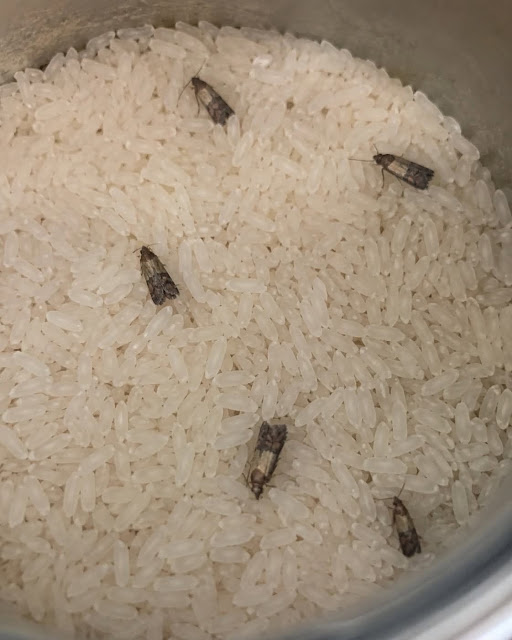
How do pantry moths get into my house?
They can sometimes enter through contaminated food products brought home from a store, warehouse, or other source. They can also spread from one stored food item to another after an infestation becomes established.
Can pantry moths live in an unopened package?
Yes, depending on the packaging. Some thin cardboard, paper, and flexible packaging may not provide a reliable barrier.
That’s one reason airtight storage containers are so useful.
Do pantry moths bite?
No. Pantry moths aren’t known for biting people.
The problem is food contamination and the inconvenience of the infestation.
Are pantry moths the same as clothes moths?
No.
Pantry moths are associated with stored food, while clothes moths are associated with animal-based fibers and fabrics.
If you see a moth in the kitchen, don’t automatically assume it’s a clothes moth.
How long does it take to get rid of pantry moths?
It depends on how extensive the infestation is and whether you successfully locate every source.
Because eggs, larvae, and pupae may already be present, you should continue monitoring after cleaning rather than assuming the problem is gone immediately.
Should I throw away everything in my pantry?
Not necessarily.
You generally don’t need to discard every item simply because one package was infested.
Inspect everything carefully. Discard food showing signs of infestation, and consider transferring suitable foods into clean, airtight containers.
Can I eat food that has pantry moth larvae in it?
I wouldn’t.
If you find clear evidence of infestation—such as larvae, webbing, or other contamination—the simplest option is to discard the affected food.
Do pantry moth traps get rid of the infestation?
Not by themselves.
Pheromone traps can help monitor adult male moth activity, but they don’t replace finding and removing the infested food source.
Why am I still seeing moths after cleaning?
There may be another infested food source, or moths may still be emerging from earlier stages of the life cycle.
Keep monitoring and inspect the pantry again if activity continues.
Storage and Prevention at a Glance
For everyday pantry maintenance, think:
Inspect → clean → seal → rotate → monitor.
That’s it.
You don’t need a complicated system.
You just need to make it difficult for pantry moths to find accessible food and easy for you to spot a problem early.
The Bottom Line
Pantry moths are annoying, but they’re not unbeatable.
The biggest mistake is treating only the adult moths you see flying around.
Instead, find the food source, discard contaminated products, vacuum and clean the pantry thoroughly, inspect nearby storage areas, and keep susceptible foods in airtight containers.
And please don’t skip the monitoring stage!
A few extra minutes of checking your pantry can save you from discovering another infestation months later.
Once you’ve broken the cycle, keeping pantry moths away becomes much easier.
And there is something deeply satisfying about opening a clean, organized pantry and seeing zero tiny moths fly out.
That’s the pantry peace we’re after!
More Helpful Home Tips You May Enjoy
Continue reading on the next page →