
Other Words That Use a Similar Pattern
Jack-o’-Lantern
Jack-o’-lantern historically comes from a phrase meaning “Jack of the lantern.”
Before the expression became strongly associated with carved Halloween pumpkins, it was connected with lantern-carrying figures and mysterious lights.
The shortened o’ preserves the old “of the” construction in much the same way as o’clock.
Will-o’-the-Wisp
Will-o’-the-wisp follows a similar pattern.
The expression historically referred to mysterious lights seen over marshy ground and became associated with folklore about travelers being misled by strange lights at night.
Again, o’ represents a shortened “of.”
Ne’er-Do-Well
The old-fashioned word ne’er is a contraction of never.
A ne’er-do-well is someone considered irresponsible, unreliable, or unsuccessful.
The spelling preserves an older pronunciation and contraction that survives mainly in literary or traditional expressions.
Why Does English Have So Many Strange Contractions?
English has been evolving for well over a thousand years.
During that time, pronunciation changed, words were borrowed from other languages, common expressions were shortened, and spellings became fixed at different stages of the language’s history.
As a result, modern English contains many words that preserve forms no longer obvious to speakers today.
Some contractions became so common that people stopped thinking of them as contractions at all.
O’clock is a perfect example.
Why English Spelling Can Feel So Inconsistent
English was shaped by multiple linguistic influences, including Germanic roots, French, Latin, Norse, and many other languages.
Pronunciation also changed dramatically over time while spelling often changed much more slowly.
This helps explain why English contains so many unusual features, including silent letters, inconsistent vowel sounds, and words that share spellings but not pronunciations.
Words such as through, though, cough, and rough are famous examples of how historical spelling can remain even after pronunciation diverges.
Why Some Words Are Spelled the Same but Pronounced Differently
English also contains words known as heteronyms: words spelled identically but pronounced differently depending on meaning.
For example, tear can refer to a drop from the eye or to ripping something.
Wound can describe an injury or be the past tense of wind.
These quirks are another reminder that English developed gradually rather than being designed according to one consistent set of rules.
What About Expressions Like “Raining Cats and Dogs”?
Idioms are another layer of English history.
Expressions such as “raining cats and dogs,” “cold turkey,” or “break the ice” often make little sense if interpreted literally.
Native speakers understand them because they have become conventional expressions.
In a similar way, we understand o’clock without consciously thinking about the literal meaning of its individual parts.
Why Do Old Expressions Survive?
A phrase tends to survive when it remains useful.
Once millions of people use an expression generation after generation, it becomes deeply embedded in everyday speech.
Even if the original reason for the phrase disappears, there may be no reason to replace it.
Everyone already understands what it means.
That is why o’clock survived long after mechanical clocks stopped being a novelty.
Do Other Languages Have Similar Historical Time Expressions?
Many languages preserve old ways of describing time, calendars, seasons, and daily routines.
Because timekeeping technologies developed gradually, words associated with bells, watches, clocks, daylight, and religious observances often remain long after the original cultural circumstances change.
This is one reason studying ordinary words can reveal surprisingly rich historical information.
Does “Clock” Have an Interesting History Too?
Yes. The history of the word clock itself is connected with older European terms associated with bells.
Early public mechanical clocks often announced the hour through bells because people did not necessarily have personal clocks or watches to look at.
For many communities, hearing the hour was just as important as seeing it.
Over time, the word became associated more broadly with the device used to measure and display time.
From Church Towers to Wristwatches
Early mechanical clocks were expensive and often installed in important public or religious buildings.
As clockmaking improved, smaller household clocks became available.
Later came portable watches, pocket watches, wristwatches, digital clocks, and eventually phones and computers that display extremely precise time.
Yet despite all these technological changes, we still say things like “It’s nine o’clock.”
The technology evolved dramatically, but the expression survived.
Why Don’t We Say “Of the Clock” Anymore?
Because the shortened form became more convenient and eventually replaced the original expression in ordinary speech.
Once everyone understood what o’clock meant, saying the longer phrase was unnecessary.
This is a natural part of language evolution.
Common phrases tend to become shorter, smoother, and easier to pronounce over generations.
Can You Still Say “Of the Clock”?
Modern English speakers would generally find it archaic or unusual.
It might appear in historical writing, intentionally old-fashioned dialogue, or discussions about the origin of the phrase.
In ordinary modern speech, o’clock is the established form.
Do We Always Need to Say “O’Clock”?
No.
If the context is obvious, speakers commonly omit it.
For example:
What time is dinner?
Seven.
There is no need to say seven o’clock unless extra clarity or emphasis is useful.
Why It Still Matters
The history of o’clock is a good reminder that even the most ordinary words can contain stories about technology, society, and language.
Everyday speech often carries traces of how earlier generations lived.
Most of the time we simply use these expressions without noticing their history.
Frequently Asked Questions
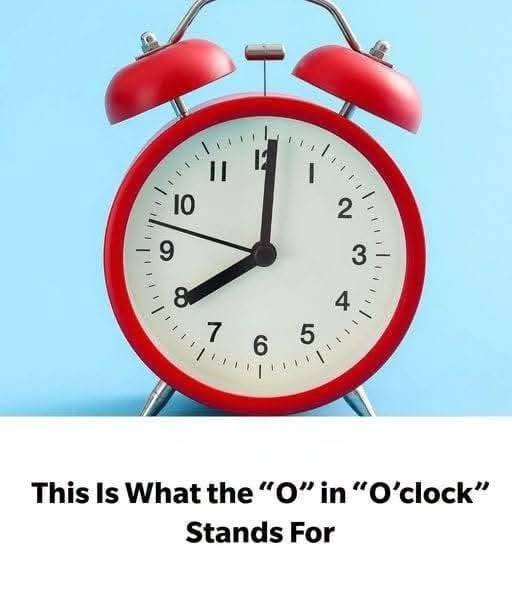
What Does the “O” in “O’Clock” Stand For?
It comes from the older phrase “of the clock.”
Why Is There an Apostrophe?
The apostrophe indicates that part of the original expression has been omitted in the contraction.
Does “Three O’Clock” Literally Mean “Three of the Clock”?
Historically, yes. It referred to three according to the clock.
Why Did People Need to Specify “Of the Clock”?
Before mechanical clocks became standard, people used several different methods of estimating time. The phrase helped identify the hour shown by the clock.
Can You Say “Three-Thirty O’Clock”?
Not in standard modern usage. O’clock is normally used with exact hours.
Is “O’Clock” One Word?
Yes. In modern English, it is written as o’clock, with an apostrophe between the o and clock.
Should the O Be Capitalized?
Not normally. It is written o’clock unless it appears at the beginning of a sentence or in a title where capitalization rules require otherwise.
Is “O’Clock” Still a Contraction?
Historically, yes. In everyday modern use, it functions as a fixed expression whose original full form is no longer normally spoken.
Is Jack-o’-Lantern Related to the Same “O”?
Yes. The o’ in expressions such as Jack-o’-lantern also represents a shortened form of of.
How Old Is the Expression?
Its roots go back several centuries to a period when mechanical clocks were becoming increasingly important in everyday European life.
The Bottom Line
The next time you look at the time and say, “It’s six o’clock,” you are using an expression that preserves a centuries-old way of speaking.
The little “o’” is not decorative. It comes from the older phrase “of the clock,” which identified the hour according to a mechanical clock.
As people repeated the phrase over generations, it became shorter and eventually turned into the familiar word we still use today.
Final Thoughts
Language is full of tiny historical clues hiding in plain sight.
A word as ordinary as o’clock can tell us about a time when mechanical clocks were new enough that people needed to distinguish clock time from other ways of measuring the day.
The original phrase may have disappeared, but its shortened form survived.
So the next time someone asks the time and you answer, “It’s eight o’clock,” remember that you are repeating a little piece of linguistic history—one that has quietly traveled through centuries of English speech to reach us today.